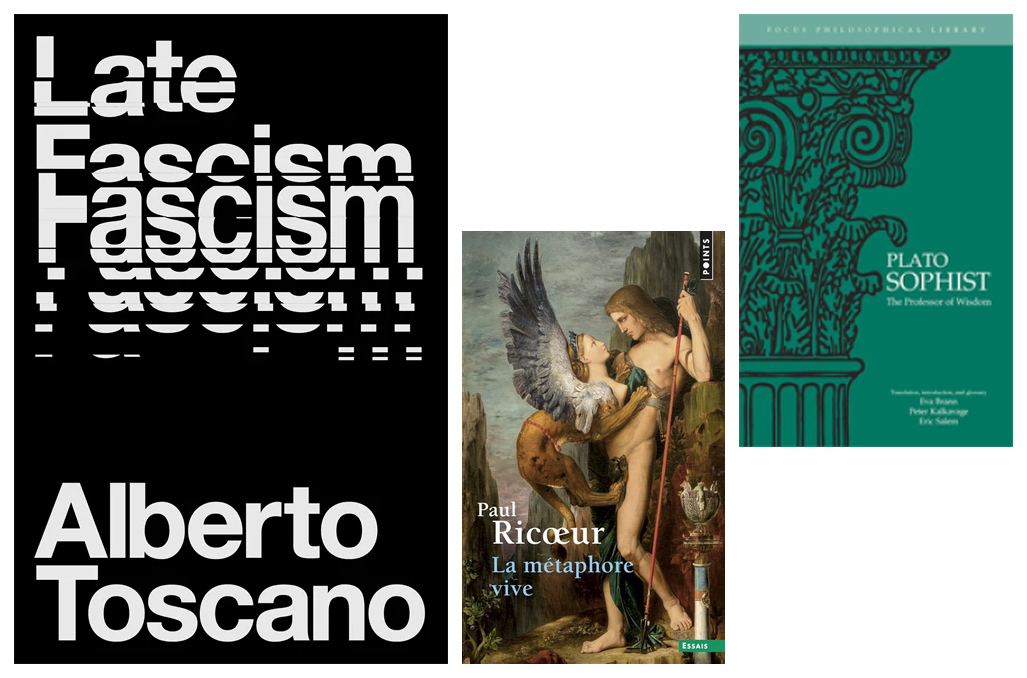
Late Fascism: Race, Capitalism and the Politics of Crisis by Alberto Toscano. Verso, 2023, 224pp.
A recipe is not a meal. Nor is a grocery list for ingredients based on that recipe. Similarly, a given recipe for making pizza dough will not be definitive for pizza dough tout court. One could go much further, extending this observation to bread in general: ingredients, styles, techniques, etc., vary incredibly across the globe—and have varied across the course of human history. Does any of that make recipes or ingredient-lists useless or suspect? Certainly not. Practically speaking, they’re often quite helpful. For novices, they can serve as an all-important starting-point for learning the skill of preparing a meal. Moreover, in many cases a list and a recipe will be part and parcel of a wider experience of training, of education or cultivation, including the specific practice of learning how to prepare food. A good learning experience will almost certainly involve that fundamental human quality: play. Preparing food and making a meal can be quite fun, a goal unto itself, thoroughly enjoyable. So there’s much more to preparing food than following lists and ingredients. And often we will come to prefer one way of preparing food to another, making a judgment about efficiency, enjoyment, and taste. Gastronomy is an art, after all. Ultimately, as we sometimes say in English, the proof of the pudding is in the eating. (Compare all of this with what Samin Nosrat writes in Salt, Fat, Acid, Heat, her excellent cookbook, when she transitions from the elementary principles of her title in the first half of her text to lists, recipes, techniques, suggestions, etc., in the second half, “Using Recipes,” pp. 198-200).
Now, all that being said, and moving from the abstract to the concrete, when we’re talking about preparing food, when we’re talking about gastronomy, that discussion is inevitably located in time and space, and it is positioned socially, culturally, and politically. I’m writing in 2026, from Montréal, Canada; I’m a white, male, heterosexual, middle-class, Canadian, Christian, socialist, living in a settler-colonial, federal, liberal, constitutional democracy (itself a polymorphous polyglot polity: English, French, indigenous; rural, urban; maritime, prairie, northern; and so on and so forth). The practice of cooking, not to mention my abstract discussion of it, which may include reference to a recipe, is not entirely distinguishable from who I am, the relationships I have, and the society of which I am a part. (Even my reference to Nosrat says something about me personally, socially, and culturally.)
In Late Fascism, Alberto Toscano worries about what I’ll call “checklist analyses” of fascism. Are they like recipes and therefore too simplistic or politically questionable? It’s true that list-making comparisons between the classical fascist heyday of the 1920s and 30s in Europe and today have become relatively common, particularly in the media. Are we living in another fascist moment, we wonder? How can we tell? Won’t this help us avoid making the same mistake? Surely today’s far-right bears some connection, some resemblance to past far-right movements, right? These are legitimate questions. Scholars such as Timothy Snyder, Richard Evans, Umberto Eco, Ugo Palheta, among many, many others, have weighed in, suggesting that there are some important parallels between classical fascism and today to which we should be giving heed, their presentations sometimes obtaining a wide audience.
Evidently Toscano isn’t wrong to caution against shortcut-thinking. A recipe cannot take the place of cooking or gastronomy. Again, it’s crucial to recall that every human activity, including preparing food but also criticism, is located and situated. Yes, the jump to analogies, as other critics caution—Dylan Riley in “What is Trump?” and Geoff Eley in “What is Fascism and Where does it Come From?”—can lead to anachronisms which distort, rather than clarify, our vision of the present. Without the lucidity of good criticism, it might be said, we won’t be able to respond to our situation with an appropriate political strategy. But how are we to relate the past to the present, if not through the categories Plato had Socrates and his interlocutors puzzle over in the Sophist, and through which Hegel powered his dialectic, namely, the same, the similar, the different, and the other?
Contrary to Toscano’s never-really-substantiated concern, then, a historical checklist can be an important element in the analogical process of reaching a considered judgment about our political present. The keyword here is element. It can be a component in the process and practice of dialectical-critical thinking: question, answer, analysis, synthesis, repeat. This is obviously a somewaht simple way of putting it. So let’s add two other Platonic reminders: that this is also an inherently rhetorical activity, subject to all the techniques by which discursive argumentation and persuasive presentation are made: comparison, contrast, humour, satire, amplification, diminution, metaphor, analogy, and so on; likewise, critical thinking is never neutral, but, as Socrates maintains in the Republic, is always directed toward a particular political ideal (the beautiful, good, just polis). To this we should add the historical commitment of Hegel and Marx: critique has historical (speculative) and material (social) conditions with which it is in dialectical relationship.
Consider Dylan’s essay, for example. He minimizes and denies an analogy between Trump’s (first) presidency and classical fascism. He does so without really making the analytical case against analogy per se, so much as presenting evidence for an alternative perspective; and this appears to be strongly motivated by the comprehensible but contestable conclusion that such analogies will (inevitably?) play into the hands of centrist Democrats—precisely the sort of people and politics that brought us to the catastrophe of our neoliberal present, as he rightly points out. It is far from clear, though, that he has made the case, or in fact wants to, for the complete incomensurability of the fascist past with the (neo-, post-, quasi-fascist?) present, or that establishing that incomensurability is as important to socialist strategy here and now. As the historian Enzo Traverso notes in Les nouveaux visages du fascisme, analogies are analogies, not homologies. We’re interested in similarity, not perfect identity (Traverso therefore prefers to call our moment as post-fascist). Whereas Riley wishes to insist on the dissimilarities of today’s far-right politics with classical fascism, perhaps motivated by a politics of rupture with the neoliberal present (to which I am rather sympathetic), Toscano, somewhat differently, wishes to avoid shallow, stereotyped, and what might be called “lazy” invocations of fascism. They, too, fail to think radically enough about our political present.
So it’s true that analogies and checklists can be shallow, misleading, faulty, and, yes, lazy. And in the rhetorical cut-and-thrust of political debate, they can be used to firm up the liberal centre. Nevertheless, as a tool with which to work, as an element in the act of thinking-through a question, making an inquiry, or addressing a problem dialectically, they can have their place. Riley seems to concede as much at the very end of his highly stimulating essay, identifying “bad analogies,” rather than analogies generally, as the problem. Eley, for his part, offers what is effectively a checklist of relevant analytical parallels between classical fascism and today (more on that below). Each of the authors so far cited do not actually deny analogies altogether; they are instead insisting on grasping our presently appropriately. But no one raises the Sophist’s puzzle: by what means are we to judge the relationship between being and non-being, between the same, the similar, the different, and the other? Again, pace Plato’s Socrates, but with Hegel and Marx, this inherently metaphysical question is not only practical and logical, it is historical. How are we to group phenomenon together, or not, in order to see and thus understand a given situation correctly? For example, is the concept of totalitarianism helpful or not for understanding the personality and politics of Mussolini, Hitler, and Stalin, not to mention the various regimes which came after them? (For a good introduction, see Traverso’s recent essay on the subject: “Totalitarianism between History and Theory.”)
In spite of his distrust of definitions, Toscano offers various comments and descriptions that do in fact circumscribe fascism. He himself engages in analogical thinking—having declared his suspicions of it. In the Conclusion, for instance, he writes that fascism “strives violently to enshrine inequality under conditions of crisis by creating simulacra of equality for some – it is a politics and a culture of national-social entrenchment, nourished by racism, in a situation of real or anticipated social catastrophe.” Such a definition—hierarchical elitism plus ethno-nationalism—has some interesting parallels with the discomfiting picture Domenico Losurdo paints in Liberalism: A Counter-History, a work which can be profitably read alongside Late Fascism. Although much of Toscano’s argument is intended to be a riposte to the notion that fascism can be exhaustively defined, as if there were a definitive fascist “recipe,” such that a checklist of “ingredients” can be created by which to measure the extent to which a given time and place is or is becoming fascist, there are nevertheless features of fascism which, as this quotation suggests, even by his own account, return and repeat. Granted, the context in which they return and repeated, having been revised, changes their meaning—a point Traverso repeatedly, and rightly, underlines in his work. As Toscano and Traverso alike acknowledge, analyzing fascism historically is never just a matter of parallels, but involves careful attention to all the specificities of time, place, and context generally (what I called location and situation above, and to which position could now be added). How, then, might we develop Toscano’s various astute observations about the variegated valences of fascism?
Perhaps like this:
First, fascism arises in response to a crisis in the form of the hierarchical and hegemonic rule of a given modern sociopolitical order. Second, fascism is areaction and response to that crisis, and/or a preventative measure against its possible arrival, in the form of a violent political rejection of egalitarian-democratic social reform or revolution. Third, fascism, as reaction and response to crisis, often takes the form of state intervention against political representation and/or civil society, where those vehicles for social change (i.e. parliaments and the like) are seeking or instituting social and political levelling, i.e. radical, revolutionary, or reformist change towards greater, participatory equality, solidarity, and freedom for each and all.Fourth, fascism is an extreme-but-not-marginal development of the forms of modern inequality that predate liberal capitalism but have been intensively developed under it: colonialism, imperialism, nationalism, racism, patriarchy, and other hierarchical social distinctions (such as class). It is important to underline that these inequalities are neither incidental to capitalism or accidental to its evolution. Fifth, given that it is inseparable from its liberal and capitalist roots, fascism is not just a form of anti-liberal totalitarianism (as Hannah Arendt argues in that striking but rather oddly stitched-together work, The Origins of Totalitarianism), it is a strategically selective political project which grants “the one” and “the few” an internal freedom and equality over the dominated “many” (the classic terms of political science—one, few, many—are mine, not Toscano’s). Sixth, fascist freedom for the dominant few over the many is a freedom typically committed to the autonomy of market capitalism—and the selective accumulation of property and wealth to which it gives rise—from democratic control. To put it slightly differently, employing a term of Toscano’s, fascism is a reactionary conservative politics of “antagonistic reproduction,” where the few seek to police, stabilize, and normalize their market-driven propertied hegemony over the many. Seventh, in the modern world of liberal nationalism, maintaining fascist freedom for the few can take a variety of forms, but quite frequently it will draw upon existing divisions, hierarchies, and ideological mysitfications, creating an elaborately embroidered and not-always-consistent scheme of insider/outsider status. For example, pitting citizens and members of “the nation” against aliens, outsiders, and others—upon whom the nation-state’s social, cultural, and political problems are cast.
Let’s come back to the notion of crisis. Given that the “wretched of the earth” (Franz Fanon’s Les damnés de la terre) frequently experience their sociopolitcal existence in terms of what can legitimately be called crisis, in the sense that their means of subsistence and their way of life is often threatened by dominant forces beyond their control (e.g. Madhusree Mukerjee, Churchill’s Secret War: The British Empire and the Ravaging of India During World War II ), elite powers which possess the top-down monopoly on violence, it is not this type of crisis which gives rise to fascism. The crisis attendant upon fascism is a crisis for the rulers and the order through which they maintain their rule. The shock of World War One, the Russian revolution of 1917, and the economic crises of the stock market crash of 1929 and the great depression of the 1930s (runaway inflation plus massive unemployment), constitute some of the key elements in the crisis which generated a fascist reaction. To cite a theorist who belongs to the critical repertoire Toscano feels most comfortable citing and invoking (i.e. critical continental theory: Walter Benjamin, Theodore Adorno, Ernst Bloch, Herbert Marcuse, etc.), the early-twentieth-century Italian socialist Antonio Gramsci would call (in his Prison Notebooks) the fascist-generating crisis a crisis of the “hegemonic bloc,” that strategic alliance between members of the ruling order and some of those socially subordinate to them (such as the middle class). Generically put, the crisis which gives rise to the possibility of extreme reaction, the fascist exception through which democracy is violently jettisoned in favour of dictatorship, is, to repeat, typically generated by the fact that powerful social and political movements of radical revolution seek to level society and in so doing establish a greater degree of equality, solidarity, and liberty for each and all. This was certainly true for fascist Italy and Nazi Germany. Their radical and violent extension of inequality, division, and difference, for all their talk of unifying (racist, ethnic) nationalism, is nowhere more apparent than in their colonial projects in Africa and, in Germany’s case, in central and eastern Europe.
Now, this rather capacious definition of fascism, which I have drawn from the observations and remarks scattered throughout Toscano’s book, is useful to the extent that it forms part of the practice of dialectical criticism, one which moves towards an always-revisable considered judgment. But, again, there is no such thing as dialectical critique without a background of already-formed commitments—in my case these include socialism and Christianity. Commitment and interrogative dialogue with self and others can and should be held in working tension: the dialectical conversation about truth, justice, and beauty never ends—which, I hasten to add, is not to say that no progress is made or firm judgments about commitments established. My sketch of fascism is therefore a “working definition.” It can serve as a starting-point for further investigation and analysis, placed in contrast with other types of political, ethical, and philosophical reflection, and suitably revised. Even if it was written in stone, which it isn’t, that stone, like the tablets of the Decalogue, is never static physically or chronologically (the ark of the covenant was mobile, after all), or impervious to changes of location, situation, and position.
And so while I think Toscano is quite right to caution against checklist analysis, Riley to warn against bad analogies, and Traverso to draw attention to the specific characteristics of different historical contexts, since a list or facile historical analogy may indeed serve as a poor substitute for the practical democratic skill of analyzing and judging, as part of the broader practice of philosophical reflection, one rooted in the virtues of theoretical and practical judgment, we shouldn’t avoid analogical and comparative thinking (impossible anyway); we should enrich it. In a more compact statement than mine, and perhaps a bit too straightforwardly, Eley suggests that “fascism can be distilled into the following: it wants to silence and even murder its opponents rather than arguing with them; it prefers an authoritarian state over democracy; it pits an aggressively exclusionary idea of the nation against a pluralism that values and prioritizes difference.” As part of his larger argument and analysis, this is an interesting, concise claim. In order to asses its possible drawbacks, not to mention those perhaps present in Toscano, Riley, Traverso, and any others (including my own work), we don’t need to be overly wary of analogies, but rather the ideological shortcuts and distortions by which bad analogies are marshalled for unjust ends.
What we need, in other words, is something Plato and Aristotle and many premodern thinkers insisted upon: the role of training, cultivation, and education, across logical, historical, rhetorical, and moral domains, in order to analogize well for the purposes of creating and maintaining Socrates’ beautiful, good, rational, just city—in my case and Toscano’s, that’s a socialist utopia (not to be confused with the utopian socialists Marx disparaged). In short, we need the “liberal arts” now more than ever. We need an education to freedom and flourishing for each and all through the study and practice of rhetoric, literature, history, and the humanities more generally, precisely because the possibility of fascism, taking new form, tricked out in new reactionary clothes, and yes, unfolding in new polarized circumstances, is a real and present danger.
Every meditation on the past, whether shallow or nuanced, including Toscano’s careful study, is a relation of the past to the present for some specific, practical reason. Toscano often writes, for instance, of the existence of fascist variants, as if fascism was virus, or the ways that fascism has repeatedly manifested itself in different times and places, such that fascism would appear to have a series of attributes whose context shapes its expression. The correct identification of variants, resemblances, and repetitions is ultimately a question of intellectual judgment, including the exercise of analogical/metaphorical thinking. Is this phenomenon here (Marine Le Pen’s Rassemblement national) the same as, similar to, different from, or other than that phenomenon there (Pinochet’s Chile or Kokkashugi in Japan)? Searching for relevant exemplars is part and parcel of the attempt to understand more and explain better, trying to sift out which phenomenon belong together and which don’t.
As Paul Ricœur asserts in La mémoire, l’histoire, l’oubli, our relation to the past, to history, is always and already a question of discursive and ontological representation. That is to say, a way of thinking about the past, an image or trace from the past, a commemoration of a past event or series of events, or even a written historical monograph by Johann Chapoutot or Richard Evans (scholars of German history generally, and Nazi Germany specifically), all “stand for” the past. That standing-for is itself an ontological-discursive process, as Ricœur argues in La Métaphore vive. Historical works invite their audience to see and connect to the past a certain way, even when, as in Chapoutot and Evans, they are very careful, detailed, analytical studies conducted according to the norms of scholarship.
Imaginative, creative, and fictional works about the past are also subject to the same conundrum, though not, as Ricœur writes in his multivolume work on the subject,Temps et récit, constrained by the goal of historical truth-telling. Consider Bertold Brecht, specifically those works, such as Mother Courage and Her Children, in which he conveys a historical episode in such a way as to render it strange, creating an alienating distance (Verfremdungseffekt), drawing attention to the features of theatrical representation in the work itself, all in order to provoke in the present an attitude, mood, stance, and reaction in the participant-spectator. By representing the past in such a way as to render it almost entirely relative, Brecht seeks to make conscious the constructive process by which all history is recounted and all artworks made. He does so because that same constructive practice was, in his estimation, at the heart of a revolutionary orientation which could realize the socialist project of utopia. Here aesthetic-historical re-presentation is a self-critical, highly hermeneutical clarion call, one which might disrupt our comfortable grasp of the past through provoking anachronisms and, in certain sense, “bad” analogies. While Brecht’s work isn’t historical in a scholarly sense, what it does do, through artistic imagination, might bear on historical analysis acutely. That is, if its aesthetic provocations can lead to fruitful reconsiderations and repositionings, from a historian’s critical vantage-point, animated by a certain faithfulness to truth. Not only do historians and their readers alike need to develop the democratic skill of making and judging analogies, including historical ones, on an aesthetic-existential level they need to learn to be open to analogical and historical provocations like Brecht’s, or what the philosopher Jonathan Lear has called the disruptive and disorienting virtue of irony (see The Case for Irony).
In Late Fascism Toscano praises Eley’s perceptive essay, which advocates for a dialectical process of critical judgment entailing historical contextualization and analytical decontextualization. I’ve already suggested that all historical study is anachronist, or decontextual. The challenge is not the impossible task of avoiding anachronism altogether, but rather to identify what constitutes “good anachronism.” How can the past be related to the present in such a way that the truth of the past is “unconcealed” (to invoke Heidegger’s way of putting it)? To take the two most famous proponents and practitioners of the Cambridge School of intellectual history, when Quentin Skinner and J. G. A. Pocock situate a particular text or discourse in specific historical contexts, such as Renaissance republicanism, the English civil war, or the American revolution, or when they place them within paradigmatic linguistic traditions, such as “Atlantic republicanism” (Pocock/Skinner) or the “ancient constitution” (Pocock) or the studia humanitatis (Skinner), they are evidently not trying to recreate the past “as it really was” (Ranke’s famous phrase). They construct a written historical-analytical representation which, ideally, enables their audience to have “ears to hear.” In other words, there can never be a contextualization that isn’t already and at the same time a decontextualization. The “sin” of anachronism, as J. C. D. Clark claims in English Society 1660-1832 (see the “Keywords” in the second edition), isn’t simply judging the past by the present—for that is precisely what historians do—but judging the past by the present without properly entering into its (possible) strangeness, its dissimilarity, its difference from the present. To his credit, Clark helped restore the central sense in which the British past, like so much of human history, is incomprehensible without coming to terms with its religiousness—a move which, although overstated, he made against his ideological rivals, big, bad progressive liberals (Roy Porter, say) and Marxists (Christopher Hill, say). Does that mean we should we then circumscribe ourselves to the past’s religious understandings of a given society’s social order, because of its supposed paradigmatic dominance? Readers of Clark’s work will be forgiven for suspecting that the alienation he seeks to re-present in England’s past (Anglicanism) is not unconnected from his present-day, political vision of “English society.”
The question remains, then: how exactly do we fix the boundaries which constitute the right horizon for a given historical context? Is it the Cambridge school’s “ordinary language / analytical” circumscription? Is it Hans-Georg Gadamer’s existentialist, hermeneutic historicism? Is it Pierre Bourdieu’s historical sociology of fields, doxa, practice, and habitus? Is it Walter Benjamin’s Messianic-Marxist-modernist—and deliberately anachronistic—“revolutionary criticism”? Is it John Milbank’s “radical orthodoxy,” which aims to restore theology to its title of queen of the sciences, over history? And those are just a few (white, male, European) possibilities.
When fundamentalist Protestant Christians say that the Bible is the inerrant, inspired, literal, perspicacious word of God (i.e. what the sociologist Christian Smith has called “biblicism”), this is a historical, literary, philosophical, and theological claim. What is wrong with the fundamentalist representation of the Christian past, and that of its central texts, including the Bible, is not merely that it is anachronistic, acontextual, and ahistorical, which it certainly is. Rather, it is the way in which its analysis relates to its subject, the way its decontextualization relates to its (implicit but ostensibly negated) contextualization. Anachronistic analysis and judgment which refuses to engage with the concrete and possibly alien particularities of an historical context—perhaps in the name of confessional beliefs (e.g. Synod of Dort), themselves a mixture of historical and analytical judgments—has neither eyes to (truly) see, nor ears to (really) hear. Often, fundamentalist and conservative Christians hold up the past and the Bible as if it were a mirror to themselves (contemporary translations of sacred texts being in this regard an all-too-easy step towards untruthful, truly bad anachronism), rather than self-consciously integrating the fact that, historically and metaphysically (and even psychoanalytically), to cite the apostle Paul, “we see through a glass, darkly.”
In order to combat conventional characterizations and analyses of fascism, in Late Fascism Toscano wants to demonstrate that many of the accepted features of the phenomenon are, upon closer examination, not as straightforward as has often been thought. For example, he repeatedly draws our attention to observations about fascism made by the pioneering nineteenth-century Black sociologist W. E. B. Du Bois, who called fascism “the counter-revolution of property.” On the flip side, Du Bois described antifascism as “abolition democracy.” Here we have a prominent Black theorist making the case that capitalism, racism, and fascism should be analyzed together. Generally speaking, at least in much mainstream scholarship, writing, and media presentation, discussions and analyses of fascism have not linked race to capitalism. Toscano seeks to draw attention to this fact, and to argue that it is an egregious, sympotmatic oversight. With Eley’s essay in mind, we could call Du Bois’ considered judgment the analytical conclusion of his sociological and historical contextualization. In his view, the abolition of racist hierarchy is part and parcel of the abolition of all the forms of unjust social hierarchy. Working from this conclusion, Toscano suggests that, for example, Ku Klux Klan terrorist violence against Black reconstruction (in the late 1800s-early 1900s), Italian squadrismo against the organization of labour in Italy (during the 1920s-30s), and the neoliberal constitution of Pinochet’s Chile (in the 1970s-80s), can all be classified as part of the fascist “counter-revolution of property.”
By attending to the work of black radicals, scholars, activists, and writers on fascism, including not only du Bois, but Cedric Robinson, Walter Rodney, Stuart Hall, Angela Davis, Ruth Wilson Gilmore, and others, Toscano also draws attention to the fact that, for those not part of the white, male, elite, liberal establishment, whether in the periphery (colonies) or the metropole (Europe/America), modern democracy, nationalism, and capitalism have been experienced by many people and groups as a form or variant of fascism. For instance, Davis (Abolition Democracy: Beyond Prisons, Torture, and Empire) and Wilson Gilmore (Golden Gulag: Prisons, Surplus, Crisis, and Opposition in Globalizing California), in parallel with Michel Foucault (Surveillir et punir), have made a powerful and persuasive case for seeing the “prison-industrial complex” in the USA and elsewhere as a part of the history of fascism. That is to say, the state-sanctioned incarceration of huge numbers of racialized people, based on the state’s monopoly of violence, which includes policing, discrimination, and exploitation, is not merely the expression of personal or social prejudices, though it is that; it forms an integral part of a social and political contest over the distribution of goods and access to power (as it does in France too). Just a few years ago, Steve McQueen, director of Twelve Years a Slave,sought to re-present the experience, resistance, joy, and journey of the Black Caribbean community in postwar England in a mini-series significantly entitled Small Axe (a Jamaican proverb and the title of an important scholarly publication run by the accomplished anthropologist David Scott). This artwork is a testimony not just to the realities of a fascism-adjacent era in British political and social life (the symbolic name to be invoked here is of course “rivers of blood” Enoch Powell), particularly as experienced by the Black Caribbean community, but also a work of “salvage” (to use a term Toscano employs, and the title of a radical journal for which he has written), recovering and retrieving the experience, struggle, and dignity of British citizens who aren’t usually represented in the national repertoire of stories.
In addition to the intimate links between modern racism and fascism, to the uncomfortable reality of the injustices, inequalities, and unfreedoms for many in our modern democratic nation-states, Toscano also asks his readers to reconsider the notion that fascism is primarily an emotional rejection of reason. Often enough, fascism has been portrayed as an irrational fanaticism, typically seen as blind devotion to a charismatic leader, the mass movement he leads, all of which is taken as the emblem of the “great” nation. However, if fascism isn’t entirely coherent, doesn’t base its appeal primarily on rational claims, that doesn’t mean it is best seen as fundamentally irrational or emotional. Instead, when viewed in the light of its social and political objectives (to wit: a revanchist counter-revolution of property), fascism’s incoherence can work as a strategy for the dominant few trying to persuade as many people and groups as possible to identify with its rule and program, frequently drawing upon ideals, aspirations, desires, and even forms of lifethat predate fascism, projected into a reactionary-yet-modernist future. As he shows, the Nazis tapped into fears of decline and status anxiety, in many cases related to modernization and capitalist development, promising fulfillment of “utopian” dreams whose origins lay in Germany’s premodern popular culture. Fascism is therefore not necessarily just an irrational idolization of the state and/or the illiberal destruction of civil society. Instead, fascism appeals to the identity and status of those whom it wants to include as insiders—up to a point. For as Toscano notes, the fascist appeal to identity and inclusion must always walk the tightrope of striving to appeal to “the masses” (as atomized individuals, or Jean-Paul Sartre’s “serialized” collectivity) while preventing them from developing self-conscious collective autonomy (popular solidarity), since the latter would, by definition, threaten the rule of the one/few. If fascism is contradictory and incoherent, looking forward to a radically reimagined future, for example, while drawing upon myths from the distant past, mixing obscurantist occultism and technological modernization at break-neck speed, as the Nazis did, that is because there is enough criss-crossed coherence among the contradictions to generate a sufficiently high level of identification for many of the people to whom it appeals (not that fascists come to power by legitimate, popular means, mind you—a point Chapoutot stresses).
Another truism that Toscano seeks to overturn about fascism is that it is entirely antagonistic to liberalism. In actual fact, historically, fascism has often had a very close relationship to liberalism, animated by liberal ideas about the relationship between the market and society. Drawing on speeches from the 1920s, Toscano shows that Mussolini described fascism as a heroic movement which would save capitalism from the socialist state. In parallel with far-right movements today, as well as the broad neoliberal consensus by which our globe is currently managed, fascists used the state to cut the state down to size—rather like Elon Musk’s Orwellian Department of Government Efficiency. Both actual fascists, such as Mussolini, and architects of neoliberalism, such as Ludwig von Mises, saw fascism as a state-led movement in the service of saving classical economic liberalism (Ronald Reagan’s famous “the government is the problem,” not the solution). In the interwar period and since, neoliberalism has frequently sought to institutionalize, and sometimes even constitutionalize, the state’s capacities to protect the market—over and against popular democratic and socialist control (for more on this, see Le choix de la guerre civile). Given that neoliberalism “is defined by the production and reproduction of inequalities and exclusions inconsistently accompanied by formalistic and formulaic commitments to rights, diversity, and difference,” contrary to what liberals generally, and those following Canada’s current Prime Minister, Mark Carney, would have us believe, there is nothing genuinely progressive about neoliberalism. In keeping with the Progressive International’s stated aims and convictions, here I am using the term “progress” to signal movement towards a levelled society (yes, invoking the Levellers and True Levellers in seventeenth-century England—see John Rees, The Leveller Revolution), where equality, solidarity, and freedom for each and all is realized not just on the material plane (economically), but culturally, politically, and existentially. Toscano goes so far as to argue that one cannot be anti-fascist without being anti-capitalist, an argument paralleled recently by Arun Kundani in What is Antiracism? And why it means anticapitalism.
If fascism has not been completely illiberal, as Toscano shows, it has not been entirely opposed to freedom either. Drawing on Johann Chapoutot’s Libre d’obéir and La loi de la sang, Toscano relates how the Nazis promoted a “fascist freedom” of the one/few over the many, deputizing and decentralizing certain administrative and institutional roles, giving their functionaries and subalterns authority and freedom to manoeuvre, not to mention opportunities for enjoyment. The terrifying reality of Nazi rule, then, is not simply some sort of total submission to the state or charismatic leader, but, for a select few, a certain way of seeing their fascist activities as autonomous and free. Here I’m reminded of another recent film, Zone of Interest, which follows the story of a Nazi settler-administrator family stationed at Auschwitz, Poland (after writing this I learned that Chapoutot also admires the film). Toscano suggests that the fascist state was not necessarily a unified Leviathan so much as a moderately multifarious Behemoth (an analogous argument to that first made by Franz Neumann in the postwar era), where Nazi bourgeois bureaucrats, as in the film, could and did carve out a settler-colonial idyll through horrifying, murderous violence and terrifying exploitation.
Having sketched out a working definition of fascism based on his book, and having explored some of the aspects of fascism neglected by many accounts which he provides, what, then, does Toscano actually say about our possibly “late fascist” moment? One element of the early-twenty-first-century present that does not resemble the fascist past of early-twentieth-century Europe is the counter-weight of collective, politically organized and self-conscious labour. Eley, Riley, Traverso, and Toscano each underline this fact. As of 1989, the chapter of Soviet internationalism is more or less closed. The Russian revolution of 1917, and the global force of Soviet communism thereafter, is not something over and against which western liberal democracy and free market capitalism has to contend or define itself today. Ever since the global dominance of neoliberalism began (for my purposes, let’s say from the 1980s, with Thatcher, Reagan, Mulroney, Xiaoping, Pinochet, et al.), and once 1989-91 was in the rear-view mirror, the international political and economic order has moved away from a dualist Cold War mentality to a more preventative and anticipatory mode of the reactionary “counter-revolution of property.” In addition to policing terrorism and “radical Islam,” rather than responding to the immanent possibility of radical socialism or revolutionary communism (as in the aftermath of 1917), i.e. rather than an actually existing “utopia” with real world political consequences, the politics of far-right reaction today is much more content to use the state, state-based alliances (such as G7), and para-state institutions, particularly (non-democratic) economic ones (the World Bank, International Monetary Fund, etc.), to carry-out strategic hegemonic manoeuvres which anticipate and extinguish beforehand the possibility of popular democracy creating a levelled society. Now that the welfare state has been tamed and trimmed, it can be instrumentalized in order to institutionalize neoliberalism, striving, so far as it may be possible, to immunize society against any forms of progressive levelling.
As Toscano holds, this helps explain the caricatured overreactions to social and political movements such as Occupy Wall Street, Black Lives Matter, and #MeToo—Canadians might add #IdleNoMore—which, each in their own way, sought to address a panoply of hegemonic inequalities pertaining to class, race, nation, colonialism, and gender. Witness the unhinged reactionary hyperbole which has often made its way into mainstream politics in the USA, Canada, France, and elsewhere, over such phenomenon as critical race theory, the 1619 Project, gender studies, and “wokism”—in Canada this takes the form of residential school denialism. Given that nation, class, race, gender, and colonialism/imperialism, are subjects treated with varying degrees of intensity during grade-school education in these respective countries, there is something akin to an ideologically-motivated moral panic about how sexuality, history, and politics are taught there. On the flip side of such anxious revanchisme, the early-twenty-first century has seen not only a disturbing proliferation of patriarchal (“masculinist”), white, and ethno-nationalist movements, but a packet of adjacent conspiracy theories: QAnon, Boogaloo, Oath Keepers, Proud Boys.
So the titanic struggle between fascism and communism in a context of crisis has no direct or close parallel today. In that sense—and it is an important difference—the contemporary situation in 2026 is noticeably different from the interwar years (1920s and 30s). The current crisis, while planetary in scope, and possibly more fatal, apocalyptic even, is in many ways more circumscribed and diffuse. The specific conjuncture of classical fascism—World War One, the Russian revolution, the stock market crash of 1929, the great depression, rapid nation-building and imperial ambitions of Germany and Italy, the mass parties of mobilization—is not being reproduced. That is not to deny that there are some important markers of similar scope in our own time, though much more chronologically and geographical dispersed, such as 9/11, the 2008-9 global financial crisis, the Covid pandemic, and the steady progression of climate-change induced catastrophes (e.g. the devastating flood in Nepal in August of this year, or the unprecedented heatwave this summer in France). Likewise, as Eley insists in his fascism checklist, there is a parallel between the current level of polarization and political stalemate, leading to distrust and frustration with democratic political institutions, with classical fascism. Furthermore, there are political leaders, Donald Trump being the most flamboyant and grotesque, willing to flout the established rules, conventions, and legal framework of constitutional liberal democracy.
In response to the ravages of neoliberalism, whose consequences include not just appalling inequality, the withering away of public services and public goods, but also environmental degradation on an extinction scale, the progressive, radical left has not mounted a widely popular or powerful program. General strikes and mobilizations remain relatively rare, though there have been strikes of a sizeable scale in India (2026) and large protests in France (gilet jaunes in 2018, the lycéennes in 2026) in recent years. These are notable movements of sociopolitical resistance, and they join the ranks of the others listed so far. Still, unlike the context of classical fascism, there is no concerted, lasting, and effective political movement today, popular on a wide scale (La France insoumise gets about 20-30% of the vote, for example), to the extent that it embodies a destabilizing and revolutionary commitment to equality, solidarity, and freedom for each and all, standing its ground and making itself felt in the balance of power.
In addition to the absence of widely popular and powerfully organized labour movement and radical left mobilization, the nostalgia of late fascism is different from classical fascism too. As Toscano remarks, rather than millennia-long eras of supposed racial and national greatness (as with the Nazis), today’s revanchist dream, in the case of Trump’s America, reaches for the prosperity (but not the embedded regulation of capital) of postwar industrialism. There is here a kind of Gilded-Age and Fordist fantasy, projected somewhat bizarrely onto the heyday of postwar state intervention. But of course that nostalgia is selective. What is highlighted by Trump enthusiasts about this era has a leitmotif: the working conditions of the white middle class, which enabled it to achieve consumerist affluence. In effect, this is a complaint and status anxiety about the effects of globalization under neoliberalism, which has seen manufacturing and industrial jobs leave the global North and West for the South and East (for more on this theme—the possible end of neoliberal globalization—see Benjamin Kunkel’s recent, highly stimulating essay, “The New National Question”). Obviously neither Trump nor his supporters have in mind the postwar era’s historical achievements, such as civil rights, women’s liberation, or social security measures (e.g. Medicare and Medicaid). Instead we have a patriarchal, white, and (hetero) masculine picture of modernization and the achievement of American global supremacy.
Late fascism, Toscano holds, like its predecessor, is a reaction to and an entrenchment of the contradictions of capitalism. Today, we live in a neoliberal, financialized, globalized, late-capitalist world. Consider contemporary political discourse on migration. Many states in the North and West now have a political spectrum which, from the centre to the far-right, is obsessed with the “problem” of immigration (just listen to the centrist and right-wing candidates for the French presidency right now, late in 2026, including everyone from Raphael Glucksman to Gabriel Attal, Bruno Retaillou, and Edouard Philippe, to Marine Le Pen and Eric Zemour, particularly in the aftermath of the lycéennes protests). The fact that many people from the global south have and continue to make their way to the developed north-west is at least partly a result of postwar neoliberal globalization (We’re Here Because You Were There). The racist civilizational language that often accompanies today’s political discussion of immigration policy is an example of neoliberal capitalism producing a problem to which late fascism is a response—with its paranoid conspiracy of a “great replacement” and its xenophobic project of “remigration.” The states of the developed North and West need immigration for reasons of demographic and economic growth under late capitalism, but, at the same time, their hegemonic ruling orders want and need to keep labour costs low in order to maximize production and profit. So which is it? The free and increasingly rapid circulation of labour, capital, and production globally? Or the maintenance of uneven regional and national development in the service of global hierarchical hegemony? (One radical response to this capitalist conundrum, in favour of state-and-nation particularism, is the sociologist Wolfgang Streek’s recent book, Taking Back Control?)
So why are far-right, fascism-adjacent political parties and movements increasingly successful today? And does this success extend beyond the hallways of political and media institutions to popular support in civil society? In addition to the fact that the political spectrum has undeniably moved significantly to the right over the past five decades (Stuart Hall’s “Great moving right show”), far-right political parties have made important gains in recent years—at play in phenomenon such as Brexit and the newly created Reform Party by Nigel Farage (in homage to Preston Manning’s Reform Party of Canada), the normalization of Jean-Marie Le Pen’s Front national under his daughter Marine (recently condemned for corruption by France’s highest court) as the Rassemblement national, to the Alternatif fur Deutschland’s recent breakthrough victory in Saxe-Anhalt in 2026. Nevertheless, as Vincent Tiberj argues (“Où en est la droitisation française?”), the relation between far-right and centrist dominance at the political level is not necessarily reflective of a similarly widespread shift socially or culturally. He maintains that a substantial subsection of the French population is culturally and politically liberal on issues such as migration, climate change, cultural pluralism, and support for public goods. There is a discrepancy, sometimes called a “democratic deficit,” between what the French people think, want, and value, then, and what is being offered by the political establishment.
Whether neo-, post-, or late, this current of fascist politics is, as Toscano writes, “an anti-emancipatory politics of crisis”. Building upon existing inequalities, including settler colonialism, imperialism, racism, patriarchy, and capitalism, today’s reactionaries seek to stop any progress towards a more levelled society through anticipatory measures and preventative counter-violence. One of the virtues of Toscano’s book is to not only provide examples of this process, but to remind us that such fascism-adjacent politics has, for a long time, been the normal experience of different groups in different times and places: most notably non-whites, women, working people, indigenous communities, and the marginalized, oppressed, and exploited generally (e.g. recently Mona Chollet, during a radio interview about her latest book, Soigner sa peau: Exploration d’une obsession, described the incessant drive to perfect one’s beauty among women and girls today as due in the first instance to neoliberalism). Revanchisme makes itself felt according to one’s “positionality,” to use Stuart Hall’s term (see The Fatefull Triangle), or according to one’s place the social fields of culture, economy, and politics, to use Bourdieu’s image (for an accessible introduction, see his Raisons pratiques: Sur la théorie de l’action). By drawing our attention to the ways in which the politics of fascist ressentiment offers a compelling vision to those offered a participatory role in its proposed rule, Late Fascism demonstrates how the so-called nightmare of civilizational collapse is wedded to a neoliberal project of ethnonationalism—leading, among other things, to today’s nefarious obsession with borders, with immigration, with social and cultural integration.
All that being said, although far-right parties may be able to make significant electoral gains and dominate media discussions, as Toscano and others cited here rightly remind us, their rise to power or their ability to implement their retrograde social vision is by no means a foregone conclusion (“Irrésistible extrême droit”). Another world is possible.
References
Hannah Arendt, The Origins of Totalitarianism. Penguin, 2017 [1966/1951].
Bertold Brecht, Mother Courage and Her Childrenin Collected Plays: Five. Eds. John Willett and Ralph Manheim, trans. John Willett. Metheun, 1995.
Pierre Bourdieu, Raisons pratiques: Sur la théorie de l’action. Éditions du Seuil, 1994.
Johann Chapoutot, Libre d’obéir.Éditions Gallimard, 2020.
Johann Chapoutot, La loi de la sang. Éditions Gallimard, 2014.
J. C. D. Clark, English Society 1660-1832. 2nd ed. Cambridge University Press, 2002.
Mona Chollet, Soigner sa peau: Exploration d’une obsession. Zone, 2026.
Lydia Davis, Abolition Democracy: Beyond Prisons, Torture, and Empire. Seven Stories Press, 2005.
Geoff Eley, “What is Fascism and Where does it Come From?” History Workshop Journal, 91, 1, 2021. 1–28.
Richard Evans, The Coming of the Third Reich. Allen Lane, 2003.
Richard Evans, The Third Reich in Power, 1933–1939. Allen Lane, 2005.
Richard Evans, The Third Reich at War. Allen Lane, 2008.
Franz Fanon, Les damnés de la terre. Francois Maspero, 1961.
Michel Feher, Michael Foessel, and Vincent Tiberj, “Irresistible extreme droite?” Esprit, 519 Mar 2023. 93-104.
Michel Foucault, Surveillir et punir. Éditions Gallimard, 1975.
Wilson Gilmore, Golden Gulag: Prisons, Surplus, Crisis, and Opposition in Globalizing California. University of California Press, 2007.
Jonathan Glazer, director. The Zone of Interest. A24, 2023. Film.
Antonio Gramsci, Selections from the Prison Notebooks. Ed. and trans. Q. Hoare and G. Smith. New York, 1971.
Stuart Hall, The Fateful Triangle: Race, Ethnicity, Nation. Ed. Kobena Mercer. Harvard University Press, 2017. Hall talks about “positionality” on p. 129.
Stuart Hall, “The Great Moving Right Show.” Marxism Today, Jan 1979. 14-20.
Arun Kundnani, What is Antiracism? And why it means anticapitalism. Verso, 2024.
Benjamin Kunkel, “The New National Question.” New Left Review, 160 July/Aug 2026. 25-64.
Christian Laval, Haud Guéguen, Pierre Dardot, Pierre Sauvêtre, Le choix de la guerre civile: Une autre histoire du néolibéralisme. Lux Éditeur, 2021.
Jonathan Lear, A Case for Irony. Harvard University Press, 2011.
Domenico Losurdo, Liberalism: A Counter-History. Trans. Gregory Elliott. Verso, 2011 [2006].
Steve McQueen, director. Small Axe. BBC and Amazon Studios, 2020. Television anthology series.
Samin Nosrat, Salt, Fat, Acid, Heat. Simon and Schuster, 2017.
Ian Sanjay Patel, We’re Here Because You Were There: Immigration and the End of Empire. Verso, 2022.
Plato, Sophist. Trans. Eva Brann, Peter Kalkavage, Eric Salem. Focus Publishing, 1996.
Plato, Republic. Trans. Tom Griffith. Cambridge University Press, 2004.
J. G. A. Pocock, The Ancient Constitution and the Feudal Law: A Study of English Historical Thought in the Seventeenth Century, A Reissue with a Retrospect. Cambridge University Press, 1987.
J. G. A. Pocock, The Machiavellian Moment: Florentine political thought and the Atlantic republican tradition. 2nd ed., Princeton University Press, 2003 [1975].
John Rees, The Leveller Revolution. Verso, 2017.
Paul Ricœur, La Métaphore vive. Éditions du Seuil, 1975.
Paul Ricœur, La Mémoire, l’histoire, l’oubli. Éditions du Seuil, 2000.
Paul Ricœur, Temps et récit. 3 tomes. Éditions du Seuil, 1979-84.
Dylan Riley, “What is Trump?” New Left Review 114 Nov/Dec 2018. 5-31.
Quentin Skinner, Visions of Politics, vol. 3: Hobbes and Civil Science. Cambridge University Press, 2002.
Quentin Skinner, Reason and rhetoric in the philosophy of Hobbes. Cambridge University Press, 1996.
Christian Smith, The Bible Made Impossible: Why Biblicism is Not a Truly Evangelical Reading of Scripture. Brazos, 2011.
Wolfgang Streek, Taking Back Control? States and State Systems after Globalism. Trans. Ben Fowkes and Joshua Rahtz. Verso, 2026.
Vincent Tiberj, “Où en est la droitisation française?” Esprit, 538 Oct 2026. 111-124.
Enzo Traverso, “Totalitarianism between History and Theory.” History and Theory, 55 Dec 2017. 97-118. On this, see also: Domenico Losurdo, “Towards a Critique of the Category of Totalitarianism: A polysemous category.” Historical Materialism, 12,2, 2004. 25–55.
Enzo Traverso, Les nouveaux visages du fascisme. Texteul, 2017.